Hyperloop Baltics
European Hyperloop Development for the Space Economy
Addressing EU Climate, Energy, Mobility and Space Economy Goals
Hyperloop has clear potential as a space technology: low-pressure vacuum tubes, magnetic levitation, and high-speed pod dynamics share core principles with space systems. Hyperloop strengthens the economy of smart cities, positively affecting GDP while accelerating the use of space-to-Earth data. In the future, commercial deployment of Hyperloop may introduce new trade routes. The project responds to the need for resilient, cross-border infrastructure in the Baltic States. Targeting the European Green Deal, Digital Transformation 2030, and the growing space economy, we investigate how a Hyperloop layer can add measurable network-level value to high-speed corridors in the Baltics and beyond.
- High-performance, resilient logistics: Enhancing high-speed logistics with Hyperloop by evaluating network throughput, operational efficiency, and optimisation.
- Supply chain management: Applying discrete-event simulation and system-dynamics modelling to improve supply chain performance.
- Reinventing international trade: Proposing new trade routes for Europe enabled by Hyperloop infrastructure.
- Economic efficiency: Benchmarking classical (Gurobi) and quantum (QAOA/Amazon Braket) optimisation to assess generalised costs and break-even demand.
- Environmental sustainability: Quantifying energy per tonne-km, land use, and lifecycle emissions to support green transport and space-economy sustainability goals.
- Space-to-Earth data solutions: Innovative data-processing pipelines for consuming space data. Our E(G)TL model (Extract, Generate, Transfer, Load) extends classical ETL with a generative-AI step — ideal for high-volume, multivariate, evolving real-time datasets.
- Regional interconnectivity: Analysing hub accessibility and cross-border market reach.
Hyperloop for Space
Towards an interconnected Earth and beyond.
- Consumer of space data: Hyperloop networks and operations can be optimised and monitored using Earth-observation and satellite data streams, processed through advanced pipelines such as E(G)TL.
- Space manufacturing supply chains: Supporting terrestrial and near-space logistics for materials and components used in space manufacturing and in-orbit production.
- Autonomous pods for ports: Unmanned, autonomous-capsule logistics networks serving ports, airports, and spaceports with high reliability and low operational cost.
- Vital cargo delivery: Micro-Hyperloop systems using compact (~2-foot) tubes for rapid, secure transport of critical or time-sensitive cargo.
- Space economy for smart cities: Integrating Hyperloop into smart-city ecosystems that use space-derived data (Earth observation, GNSS, connectivity) for real-time mobility optimisation, urban planning, and sustainable logistics.
- Future — Moon logistics: Vacuum-tube and maglev principles enable efficient surface transport of cargo and people on the Moon, where the natural near-vacuum environment reduces the need for full tubes.
- Future — Mars surface transport: Similar dual-use potential for long-distance mobility on Mars, leveraging the planet’s low atmospheric density.
- Future — Cislunar & orbital logistics: Conceptual extension of high-speed, low-friction transport principles for cargo and component transfer in cislunar space or for in-orbit assembly supply chains.
Join the Consortium
We are actively assembling a multidisciplinary consortium to apply for upcoming Horizon Europe Cluster 5 / Europe's Rail Joint Undertaking calls, while also seeking partners for Space Economy and Space-to-Earth data projects. We welcome collaboration in the following domains:
Hyperloop & Space Technology Developers
To challenge pod, capacity, and interface assumptions, and to explore vacuum-tube and maglev systems as dual-use Space Technology.
Infrastructure Managers & Rail Operators
To validate network-integration assumptions and terminal simulation operations.
Quantum Computing & OR Experts
To collaborate on QUBO/Ising formulations and algorithm benchmarking.
Space Data & Earth Observation Partners
For Space-to-Earth data solutions: advanced ETL/EGTL pipelines, generative AI for space datasets, and monetisation of space-tech data.
Cooperation Opportunities
Beyond formal consortium membership, we offer several ways to collaborate on Hyperloop, Space Economy, Smart Cities, data processing, and quantum computing topics.
- Co-authorship on research papers: Joint publications in the Hyperloop domain, Space Economy, Smart Cities, data processing, and quantum computing.
- Design and development of joint vision: of new global trade routes enhanced by Hyperloop.
- Hyperloop scientific school: Joint contribution to a scientific school dedicated to the advancement of Hyperloop technology.
- Commercialisation of science: Joint startup development to turn research results into commercial solutions.
- Guest lectures and educational outreach: Partners can present ideas, products, and innovations to students at universities and pupils at schools across the Baltic States.
- Scientific hub development: Collaboration on building a lasting scientific hub for Hyperloop and related technologies in the region.
Work Packages
Click any work package to expand details.
WP1: Governance & QA
Duration: 3 months (continuous support)
Project handbook, traceability, data management, ethics/security, reproducibility assurance, space-data processing enhanced framework. This work package establishes the foundational governance framework that ensures quality, compliance, and reproducibility across all technical activities.
Planned Deliverables:
- D1.1 Project Handbook
- D1.2 Data Management Plan
- D1.3 Ethics Assessment
- D1.4 Reproducibility and Traceability Framework
- D1.5 Quality Assurance Plan
WP2: Network & Scenarios
Duration: 6 months
Development of the Rail-Hyperloop network model, baseline generation, and candidate link identification, with scenarios linking terrestrial and space-economy corridors. This work package builds the foundational network representation that all subsequent optimisation and simulation activities will use.
Planned Deliverables:
- D2.1 Rail-Hyperloop Network Model
- D2.2 Baseline Scenario Set
- D2.3 Candidate Link Identification Report
- D2.4 New Corridor Scenarios
- D2.5 Current EU trade routes assessment
- D2.6 Potential new trade routes identification
WP3: Strategic Link Selection
Duration: 8 months
Quantum-classical optimisation using Gurobi reference models, QUBO/Ising encodings, and Amazon Braket benchmarks. This work package develops and benchmarks advanced optimisation methods for selecting the most strategic Hyperloop links within the network.
Planned Deliverables:
- D3.1 Classical Optimisation Reference Models (Gurobi)
- D3.2 QUBO/Ising Encodings for Link Selection
- D3.3 Quantum Benchmark Results
- D3.4 Strategic Link Selection Recommendations
WP4: Pod Scheduling
Duration: 6 months
Transportation allocation, rolling-horizon pod assignments, and slot assignments under demand stress tests — methods applicable to space logistics. This work package develops scheduling algorithms that ensure efficient and resilient pod operations.
Planned Deliverables:
- D4.1 Pod Scheduling Algorithms
- D4.2 Rolling-Horizon Assignment Models
- D4.3 Demand Stress Test Results
- D4.4 Applicability Assessment Validation
WP5: Terminal Simulation
Duration: 5 months
Intermodal terminal discrete-event simulation addressing queues, handling variability, and operational disruption. This work package models the critical interfaces between Hyperloop and conventional transport modes.
Planned Deliverables:
- D5.1 Discrete-Event Terminal Simulation Model
- D5.2 Queue and Handling Variability Analysis
- D5.3 Operational Disruption Scenarios
WP6: System Dynamics & Integration
Duration: 10 months
System dynamic modeling, platform integration, EGTL data processing pipelines for satellite data, and validation to reach Technology Readiness Level (TRL) 4. This work package integrates all technical results into a coherent system dynamics model and validates the overall approach.
Planned Deliverables:
- D6.1 System Dynamics Model
- D6.2 Integrated Platform
- D6.3 Validation Report
- D6.4 Long-Term Scenario Analysis
- D6.5 TRL Asessment
- D6.6 Policy and Regulation Proposal
WP7: Training
Duration: Full project duration (peak in final 6 months)
Scientific dissemination, policy/industry workshops (including Space Economy events), open science releases, and career development planning. This work package ensures the project’s results reach the scientific community, policymakers, and industry, while supporting the professional growth of participating researchers.
Planned Deliverables:
- D7.1 Dissemination, Hyperloop Promotion and Communication Plan
- D7.2 Policy and Industry Workshop Series
- D7.3 Open Science Data and Model Releases
- D7.4 Partner Network Development
- D7.5 Training Activities
- D7.6 Conferences organisation
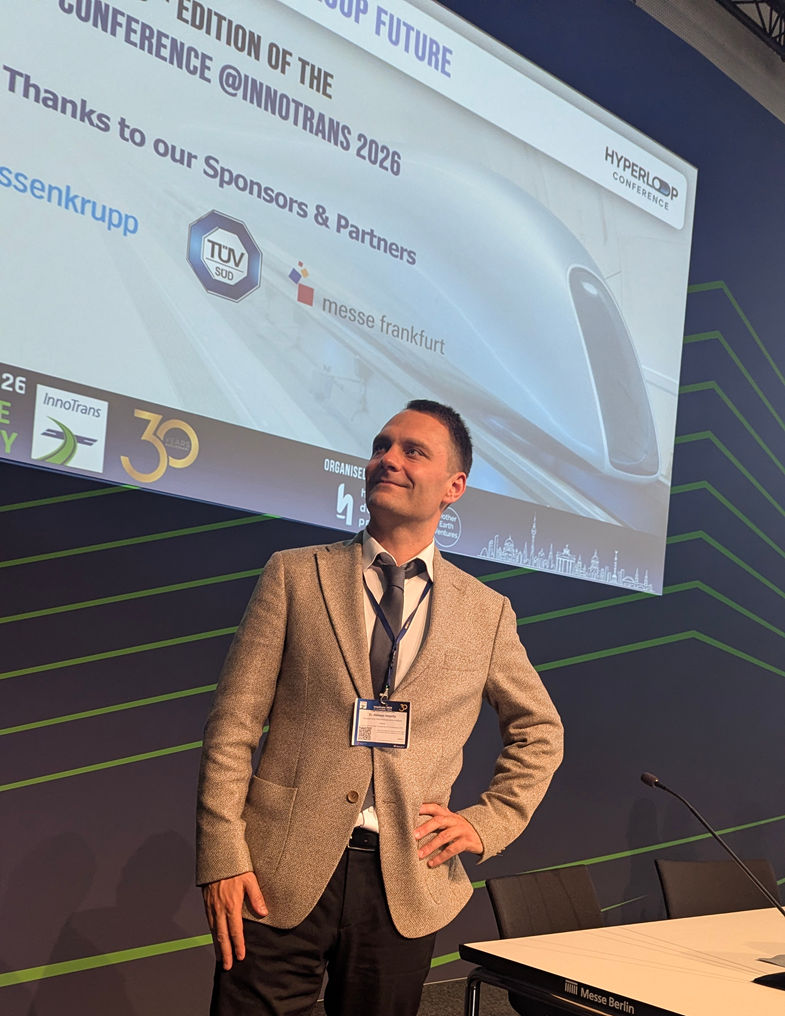
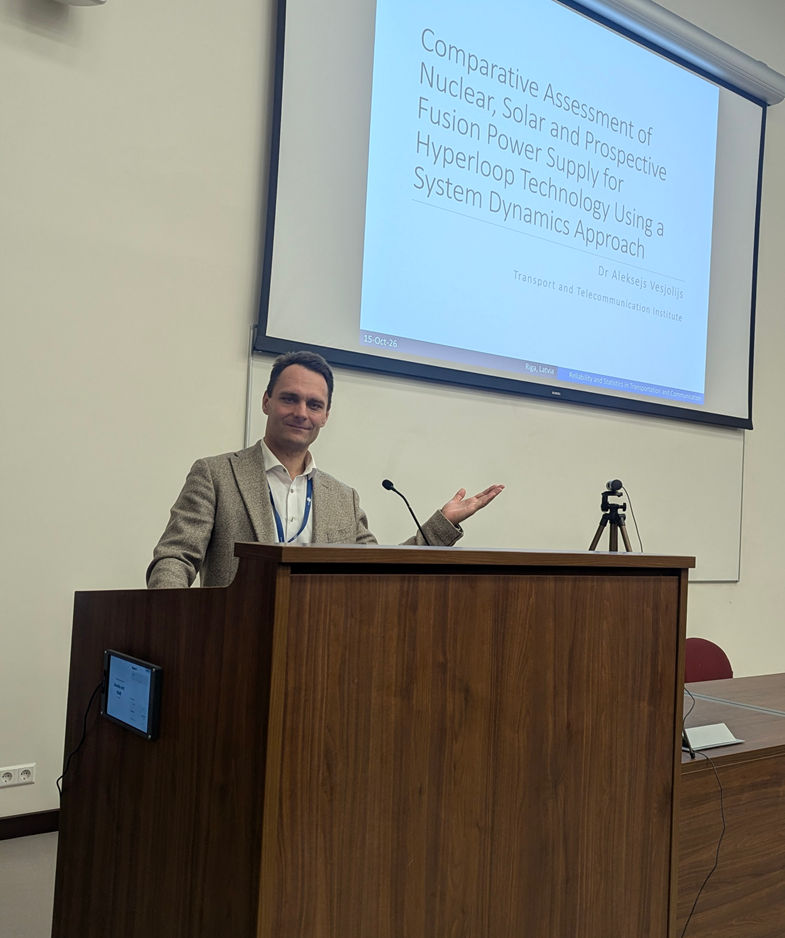
Recent Engagements

Publications
Selected works by Dr. Aleksejs Vesjolijs (full list on ORCID).
- PhD Dissertation: Decision-Making Framework for Hyperloop Technology Project Implementation (2025). Transport and Telecommunication Institute.
Summary (LV/EN) - Hyperloop Routes Optimisation Considering Barren Soil, Case of Latvia (2025). Book chapter.
- A Framework for Quantifying Hyperloop’s Socio-Economic Impact in Smart Cities Using GDP Modeling (2025). Economies.
- Evaluation of Hyperloop Technology Project Maturity Through System Dynamics: Modelling and Simulation (2025). Economics and Business.
- Assessment of Socio-Economic Impacts of Hyperloop Technology on European Trade Routes (2025). Economies.
- The E(G)TL Model: A Novel Approach for Efficient Data Handling and Extraction in Multivariate Systems (2024). Applied System Innovation.
- Hyperloop Decision Making Ecosystem Empowered by Ambient Artificial Intelligence (2024). Conference paper.
- Overview of Factors and Methods for Analysis of Hyperloop Project (2024). Conference paper.
- Context-Aware Personalized Route Recommendations for Bicycle Users Using Large-Scale Mobility Data (2024). Conference paper.
- Applying Simulation System to Compare the Use of Electric and Diesel Truck Fleets (2024). Conference paper.
- Implementation Framework for Hyperloop Decision-Making Ecosystem (2024). Conference paper.
- A Modelling System for Evaluating Options for Building and Using a Fleet of Battery Electric Trucks (2022). Transport and Telecommunication.
- Ec-Funded Projects' Lessons Learned In Earth Friendly Freight Transportation (2022). Transport and Telecommunication.
Educational Institution Affiliation
We are currently exploring the development of this partnership framework in collaboration with the Transport and Telecommunication Institute (TSI). Please note that discussions are ongoing and the hosting institution is not yet finalised; the affiliation may evolve as the consortium takes shape.
Contact the Project Coordinator
Dr. Aleksejs Vesjolijs
Project Coordinator • Assistant Professor, Transport and Telecommunication Institute
Space-to-Earth Data Solutions • Driving the EU Hyperloop
- Email: alex@hyperloop.lv
- Phone: (+371) 26878952
- LinkedIn: linkedin.com/in/alex-veseliy
- ORCID: 0009-0008-2845-7498
- Location: Riga, Latvia (EU)
- PhD Dissertation (EN): Decision-Making Framework for Hyperloop Technology Project Implementation
- PhD Summary (LV/EN): Download PDF